Managing Cost Structure Through Downturns – Week #51 of The Financial Operating System®
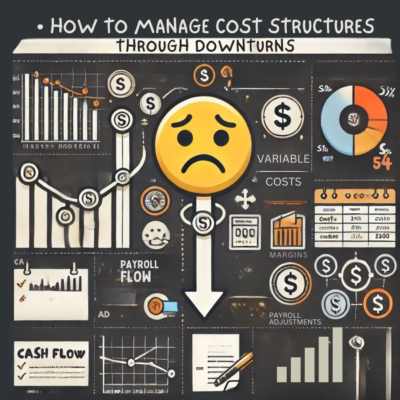
Managing cost structure through downturns is essential for businesses facing declining sales or economic downturns. This chapter provides a systematic framework for prioritizing cost reductions, maintaining operations, and preserving the ability to recover when conditions improve.
5-Step Framework for Managing Costs During Downturns
1. Assess Sales Scenarios
- Evaluate each revenue stream and assess the risk of decline.
- Forecast scenarios, ranging from modest to severe declines, to understand potential impacts.
- Focus particularly on customers contributing significant sales volumes and assess their likelihood to scale back or discontinue purchases.
2. Assess Direct Cost Structure
- Analyze variable costs (e.g., third-party services resold) and fixed costs (e.g., salaried positions) related to delivering services or goods.
- Identify areas where variable costs can be reduced or eliminated without impacting service quality.
- Project direct costs under different revenue decline scenarios to evaluate changes in margins.
3. Assess SG&A Cost Structure
- Separate Marketing & Sales and General & Administrative (G&A) expenses into fixed and variable components.
- Forecast how these costs evolve across revenue scenarios to identify potential cost-saving opportunities.
- Prioritize maintaining essential SG&A functions that support recovery, such as customer acquisition capabilities.
4. Compile Full P&L Scenarios
- Create profit-and-loss (P&L) projections for each revenue decline scenario.
- Identify the “break-even point,” where the business becomes unprofitable, and determine the necessary cost adjustments to stay above that threshold.
5. Plan and Prioritize Cost Cuts
- Focus cost-cutting efforts on fixed costs, as variable costs naturally decrease with declining sales.
- Strategies for fixed cost reductions include:
- Adjusting employee hours (e.g., moving positions to part-time or furloughs).
- Negotiating vendor contracts to extend payment terms or reduce costs.
- Cutting non-critical expenses while preserving capabilities to serve existing customers and attract new ones.
Additional Considerations
Managing Payroll
- Payroll is often the largest fixed cost, and cutting salaries or positions may be unavoidable in severe downturns.
- Alternatives to layoffs include temporary pay cuts or unpaid furloughs to maintain the team structure.
Cash Flow Vigilance
- Maintain a rolling 13-week cash flow forecast to closely monitor liquidity and plan payments.
- Be proactive in collecting accounts receivable to avoid bad debt risks.
Balancing Decisions
- How aggressively to cut costs depends on:
- The company’s profitability before the downturn.
- The size of its cash reserves.
- Confidence in sales forecasts and future recovery.
Conclusion
By systematically assessing revenue scenarios, cost structures, and cash flow, businesses can effectively manage downturns while preserving the ability to recover. The key is to cut costs strategically, focusing on maintaining core functions and minimizing long-term damage to operations and customer relationships.
Next Step:
Business owners can self-implement The Financial Operating System. Chapters are available to download at smartbooks.com/resources or you can buy the whole book from Amazon (the marketing firm version or the general business version).
If you would like assistance with implementation or would like to accelerate results for your business, please contact author Cal Wilder at cwilder@smartbooks.com or book a free consultation with our team directly using this calendar link.