Empowering Healthy Business Podcast Episode 53 :What Business Owners Need to Know About Retirement Plan with Charles Reichelt
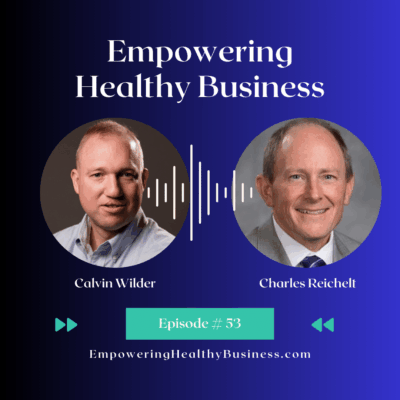
Setting up small business retirement plans can feel confusing: 401(k)s, SIMPLE IRAs, SEP IRAs, solo 401(k)s, cash balance plans, and then compliance, fees, and employee education. In this episode of the Empowering Healthy Business Podcast, Calvin Wilder talks with Charles Reichelt about how owners can choose the right structure, keep costs in check, and help their teams save for the future without adding unnecessary complexity.
Below is a clear, plain-English guide drawn from that conversation.
Why retirement plans matter for small business retirement plans
Retirement plans aren’t just a benefit; they’re a tool for the owner and the team.
- Tax advantages: Employer contributions are deductible. Plan design can also increase what the owner can contribute each year.
- Hiring and retention: Employees expect access to a plan. A simple, low-friction setup helps participation and loyalty.
- Owner outcomes: The right design can raise owner contribution limits while staying compliant with nondiscrimination rules.
The major plan types, in simple terms
401(k): the versatile “Honda Accord”
Use when: you want flexibility, options to match, and room to scale.
Why it works: You can add automatic enrollment, safe harbor features (to reduce testing headaches), Roth deferrals, profit sharing, and even “new comparability” allocations to help owners contribute more while staying fair.
Pros: Highly configurable, scalable from 10 to 100+ employees, broad investment menus.
Cons: More administration and costs than a SIMPLE IRA; annual testing unless you use safe harbor.
SIMPLE IRA: the lean, low-lift option
Use when: you have a very small team and want the easiest path.
Pros: Minimal admin, no annual discrimination testing, straightforward employer contributions.
Cons: Lower contribution limits than a 401(k); fewer design levers as you grow.
SEP IRA and Solo 401(k): for owner-only or no-W-2 teams
- SEP IRA: Employer-only contributions. Simple, but less flexible if you later add employees.
- Solo 401(k): Ideal for solopreneurs (and spouse employees). Combines employee deferrals + employer contributions for higher potential limits than a SEP at similar income levels. Often the best choice if you’re a one-person shop.
Cash Balance (Defined Benefit): for maximizing owner savings
Use when: you have strong, stable profits and want very high deductible contributions (often paired with a 401(k)).
Note: Requires actuarial support and tighter funding rules. Great for late-career catch-up if the budget supports it.
Matching the plan to business size and goals
- Solopreneur/consultant: Start with a solo 401(k). It usually beats a SEP for maxing contributions at modest incomes and supports Roth/loan features in many providers.
- 2–5 employees (steady, small team): A SIMPLE IRA keeps admin light and costs low. If you want higher limits or auto-enrollment, consider a streamlined safe harbor 401(k).
- 10–25 employees (growing): A 401(k) becomes more attractive. Add safe harbor to avoid testing issues and consider profit sharing for better owner contributions.
- 50–100+ employees: A 401(k) with well-defined governance, auto-features (auto-enroll/escalation), and fee benchmarking. If the owner needs very high savings and the budget allows, layer a cash balance plan.
Startup tax credits: Many employers qualify for federal tax credits that offset setup, admin, and even employer match costs in the early years. Don’t leave these on the table.
Compliance and cost: keep it clean and transparent
- Testing & design: Safe harbor provisions can simplify or eliminate nondiscrimination testing. If you skip safe harbor, ensure your match/eligibility design won’t cause failures.
- Fees: Know all components—recordkeeping, administration, advisory, and fund expenses. Benchmark every 1–2 years. Low cost is good, but not at the expense of poor service or confusing investments.
- Documentation: Keep your plan document, adoption agreement, investment policy, disclosures, and annual filings organized and current.
Employee education drives real results
Plans only work when people use them. Charles’s approach includes meeting employees 1:1 to explain:
- How much to contribute to reach a realistic retirement target
- The difference between pre-tax and Roth deferrals
- Simple investment choices (e.g., target-date funds) and staying the course
- The value of starting early and letting compounding do the heavy lifting
This education improves participation and deferral rates—and helps the plan pass testing.
When to review or change your plan
Do a health check if you notice any of these:
- Low participation or low average deferrals
- Frequent testing failures (or expensive fixes)
- High or unclear fees relative to market benchmarks
- Plan design that no longer fits (e.g., you’ve grown, or the owner needs higher contributions)
- Poor service or slow support from your providers
A quick benchmarking review often uncovers easy wins: switch to safe harbor, add auto-features, simplify the fund lineup, or restructure fees.
A simple five-step way to implement or fix a plan
- Clarify: Define owner goals, workforce profile, budget, and desired savings.
- Research: Compare providers and designs against those goals.
- Execute: Document the plan, onboard payroll and recordkeeping, and set timelines.
- Advocate: Educate employees and support the admin team.
- Deliver: Monitor participation, fees, and testing; adjust as needed.
Conclusion: Start simple, scale smart
Small business retirement plans don’t have to be complicated. Match the plan to your stage:
- Solo → solo 401(k)
- Very small and static → SIMPLE IRA
- Growing or need flexibility → 401(k) (add safe harbor, auto-enroll, profit sharing as needed)
- High-profit owner needing maximum savings → consider cash balance with expert guidance
Keep fees transparent, review annually, and invest in employee education. You’ll build a plan that helps the owner save more, supports your team, and stays compliant as you grow.
Want to go deeper? Listen to the full conversation on the Empowering Healthy Business Podcast